

Biodiversity Management

Goal 15:
Management Guidelines and Practices
BEM places importance on every stage of project design and construction. Therefore, the Company operates with awareness of negative impacts that may occur on communities and the environment.
The Company strictly and carefully complies with regulations, laws, and measures for prevention, correction, and rehabilitation according to the Environmental Impact Assessment (EIA). Effective technology and innovation are employed in operating processes, while regular monitoring and inspection measures are also implemented to mitigate and avoid severe impacts on biodiversity.
Impact on Business and Stakeholders





BEM as a concessionaire of transportation infrastructure systems, including expressways and rail systems, operates in urban and vicinity areas. The Company receives service areas from concession granters or government agencies. As a result, the Company's operations do not significantly impact forested areas, protected areas, regions with critical biodiversity, or areas near the aforementioned. During construction or after the opening of expressways and rail systems, the Company implements the Environmental Impact Mitigation Measures and Monitoring Program (EMP), approved by the Office of Natural Resources and Environmental Policy and Planning (ONEP) and the National Environment Board.
However, the overall loss of biodiversity may impact the supply chain. As a result, BEM faces complexities related to ecosystem degradation and possible service interruptions. Therefore, the Company has managed biodiversity risks by collaborating with stakeholders to take action in accordance with the above measures and providing support for the protection of ecosystems, natural resources, and human rights. Besides aiming for the Company's sustainability, this collaborative effort drives Thailand towards a bioeconomy and green economy.

Commitment, Challenges and Opportunities
BEM recognizes the significance of biodiversity and ecosystems, including environmental impacts, as they are the source of life and resources essential to human life.
The Company, therefore, conducts business considering environmental impacts and remains committed to maintaining the target of No Net Loss of biodiversity values and ecosystem balance while promoting Net Positive Impact in business operations and No Net Deforestation according to the corporate policy.

Targets and Performance Indicators
BEM aims to implement environmental impact prevention and mitigation measures, including monitoring and inspecting environmental quality across all areas, to uphold environmental standards and operate responsibly and efficiently. In 2025, the Company successfully achieved 100% of its targets.

All BEM's operating areas have implemented the Environmental Impact Mitigation Measures and Monitoring Program (EMP)
Targets
2025 Performance
Policy and Practices
Biodiversity and Preventing Deforestation Policy
BEM has announced a Biodiversity and Preventing Deforestation Policy to guide employees and encourage participation and collaboration with suppliers, contractors, partners, and other stakeholders throughout the business value chain.
BEM's endeavors to maintain biodiversity are based on operating guidelines that are consistent across the organization throughout the business value chain. This is in accordance with the Biodiversity and Preventing Deforestation Policy based on the following guidelines:
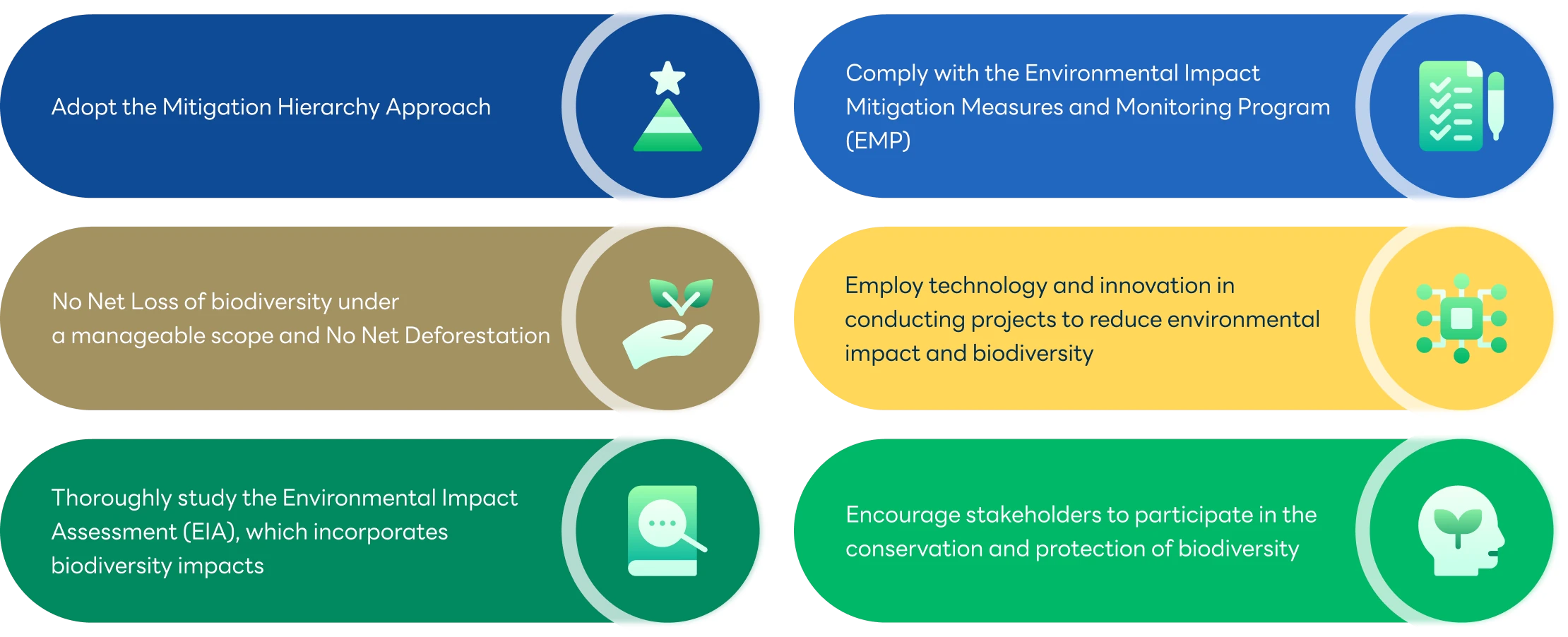
Biodiversity Management Practices
BEM has established biodiversity management practices with a systematic management process, ranging from the identification, assessment, and determination of impact management measures, as well as planning and implementing measures to conserve, maintain, and restore biodiversity in ecosystems related to its business operations.

Biodiversity Operations
BEM emphasizes project design and construction at every stage, operating with awareness of potential negative impacts on communities and the environment. The Company strictly adheres to regulations, laws, and preventive, corrective, and restorative measures as outlined in Environmental Impact Assessment (EIA) reports. Technology and innovation are integrated into operations, with regular monitoring measures to mitigate environmental impacts and prevent significant biodiversity disturbances.
BEM does not encroach on forest reserves, natural world heritage sites, or protected areas classified under International Union for Conservation of Nature (IUCN) categories I-IV.
Environmental Impact Assessment Studies, Risk Assessment, and Preventive and Management Measures
BEM has studied the Environmental Impact Assessment (EIA) Report, received from concession grantors, which covers biodiversity aspects in both terrestrial and aquatic ecosystems at all stages of project operations, including new projects and project expansions. The assessment has been conducted in strict compliance with relevant laws, such as the Wildlife Conservation and Protection Act, B.E. 2535 (1992), the Royal Decree on Restricted Timber Species, B.E. 2530 (1987), and the guidelines of the International Union for Conservation of Nature (IUCN), etc. Although BEM operates mostly in urbanized areas with Land biomes: Intensive land-use systems (T7) - Urban and industrial ecosystems1/, the Company has implemented Environmental Impact Mitigation Measures and Monitoring Program (EMP), which has been approved by the Office of Natural Resources and Environmental Policy and Planning (ONEP) and the National Environment Board. This comprehensive program helps mitigate the environmental impacts of the Company's activities, reducing business risks associated with natural impacts such as soil erosion, erosion and sedimentation prevention, drainage management, and flood prevention, etc. The EIA was conducted across an area of approximately 154,500,000 square meters along the Company's service routes, with operational areas spanning 5,119,200 square meters. Based on current projects' performances, the Company has developed action plans and monitoring plans to mitigate environmental impacts for all projects in full compliance with Environmental Impact Mitigation Measures and Monitoring Program (EMP).



In 2025
BEM conducted a review of environmental and biodiversity information from Environmental Impact Assessment (EIA)2/ reports both in construction phase and operation phase for MRT Orange Line project. The biodiversity risk review and assessment results indicated a low risk level and no significant impact on terrestrial and aquatic ecosystems. In addition, the Company conducted studies and developed biodiversity management practices aligned with international standards, including biodiversity disclosure emphasizing systematic reporting along with preparing a Biodiversity Action Plan (BAP) covering the Company's operational areas in both expressway business and rail business to establish management frameworks, assess risks, and monitor ecosystem impacts continuously.
Remark:
1/ TNFD, Version 1.0 (September 2023), Guidance on biomes: Guidance_on_biomes_v1.pdf (tnfd.global)
2/ Environmental Impact Assessment: EIA


Biodiversity Risk Review and Assessment Results

Guidelines for Natural Resources Conservation
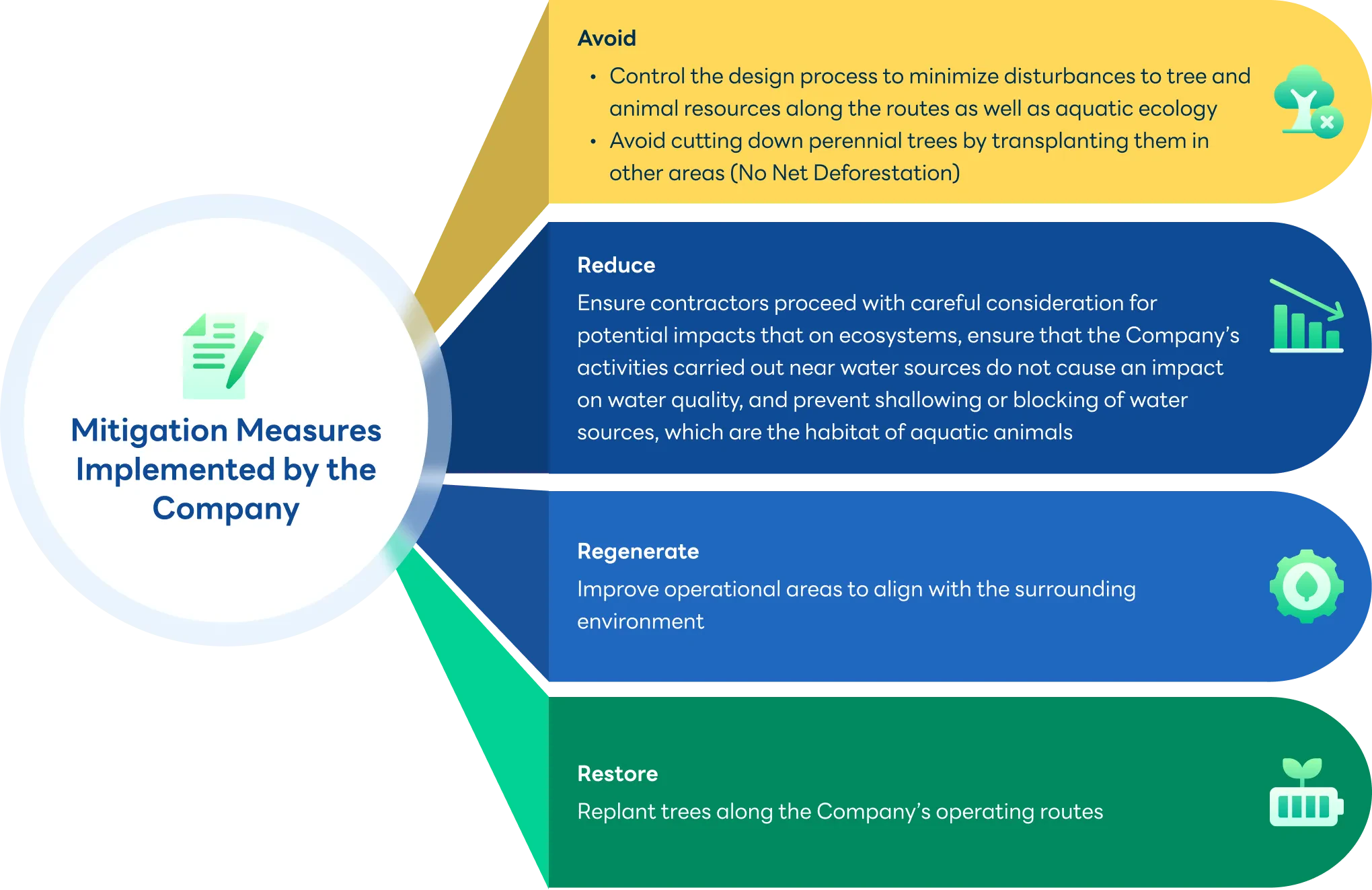
According to the Biodiversity and Preventing Deforestation Policy, BEM has guidelines for conserving natural resources, which uses a Mitigation Hierarchy approach comprising Avoid, Reduce, Regenerate, and Restore in implementing the Environmental Impact Mitigation Measures and Monitoring Program (EMP).